TYPE html>
“What, exactly, stays the same when a robot learns to do something new?”
Humans do not relearn their bodies from scratch every time the goal changes. We may learn a new skill, adapt to a new environment, or recover from a mistake, but some internal sense of the body carries forward. This project asks whether something similar can emerge inside a learned robot controller.
In this work, we trained a single robot across multiple behaviors and then looked inside the neural policy to test whether a stable, reusable internal subnetwork emerged — something closer to a persistent sense of the robot's own body than a one-off task controller.
Most robot learning systems are judged by what they can do: walk, turn, jump, manipulate, recover. But there is a deeper question underneath that performance: when a robot learns several behaviors over time, does it only store task-specific control tricks, or does it also build a more persistent internal understanding of its own body?
That distinction matters for both science and engineering. Scientifically, it gives a concrete way to study whether something self-like can emerge inside a learning system without explicitly programming it in. From an engineering perspective, it points toward controllers that reuse stable body knowledge while only rewriting the parts that need to change for a new objective.
In other words: to learn continuously, a robot should not have to rewrite what it is every time it changes what it is doing.
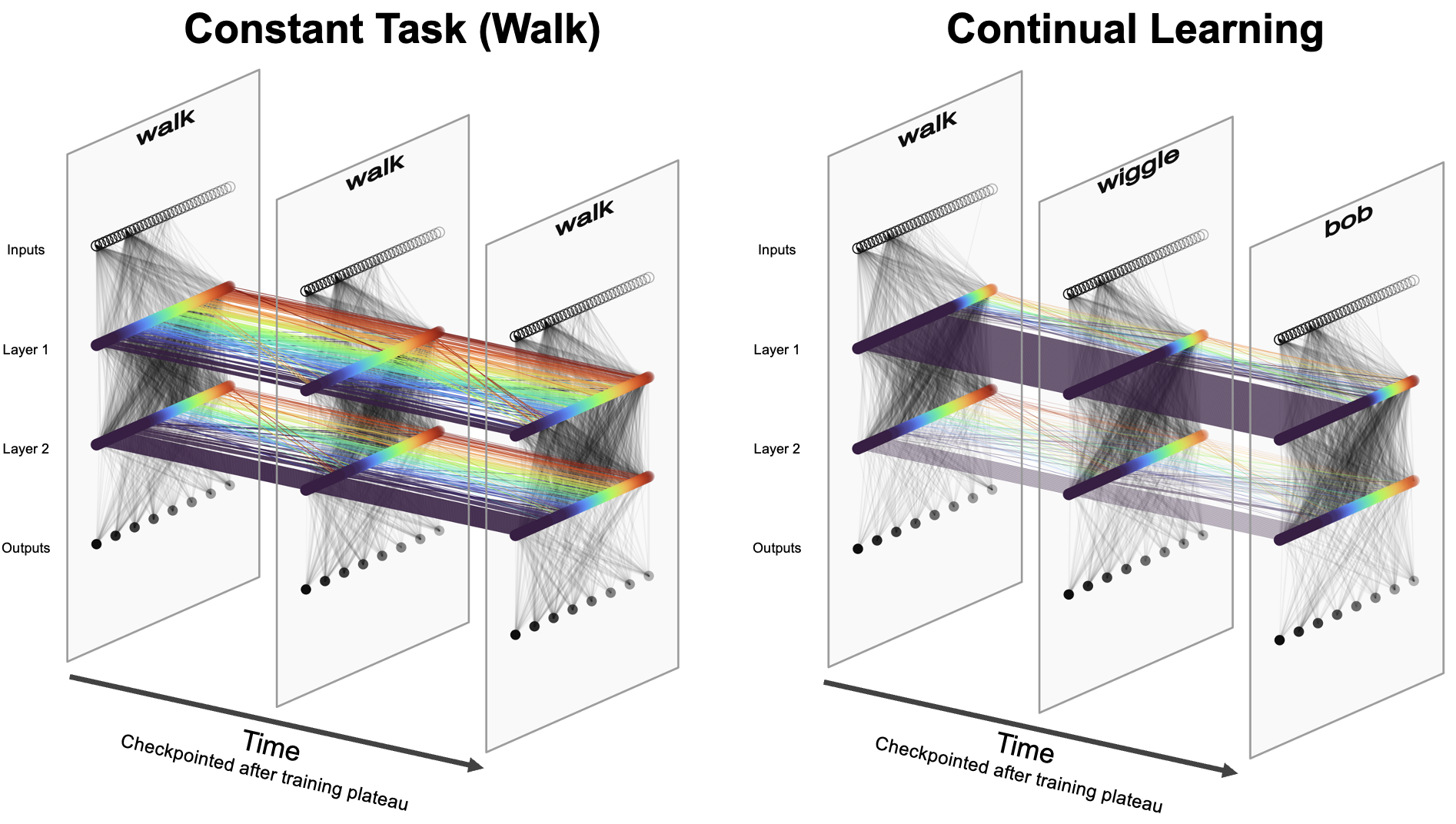
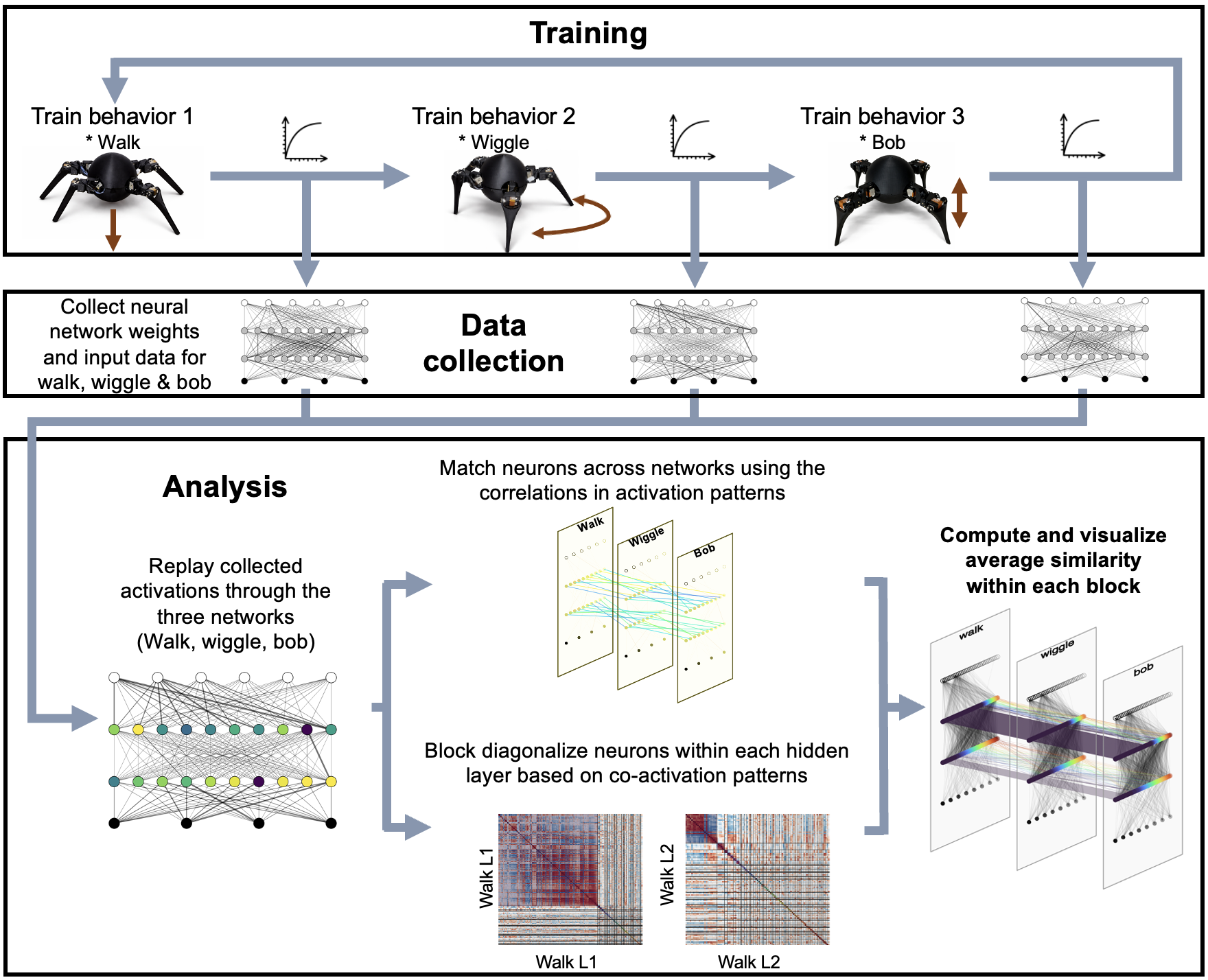
We trained a simulated quadruped in a continual-learning curriculum across three distinct behaviors: walk, wiggle, and bob. We then compared its internal neural structure against a control policy trained on a constant task.
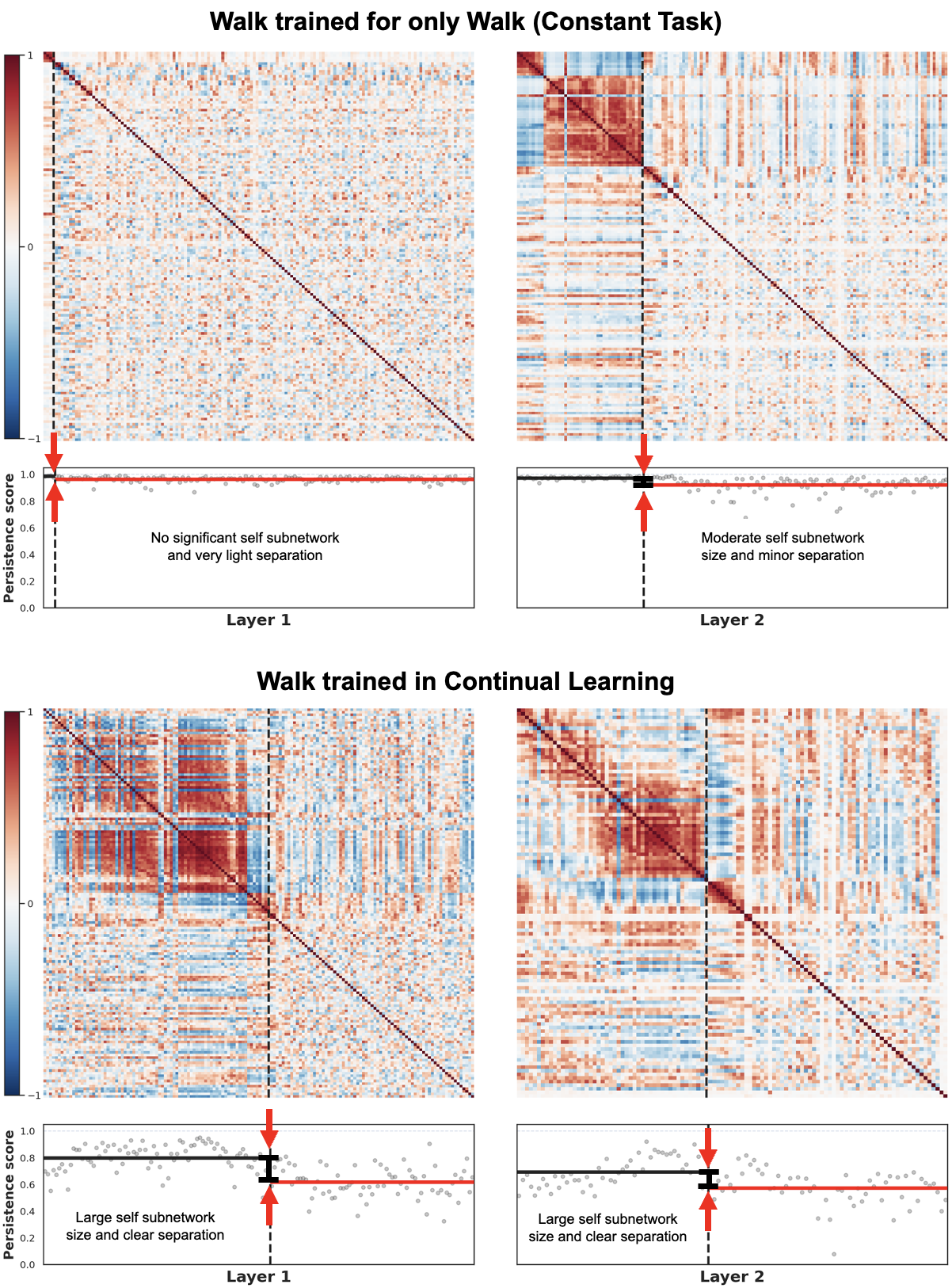
The core result was that continual learning produced a stable self-like subnetwork: a subset of the controller that remained noticeably more persistent across behavior changes, while other regions reorganized more strongly to implement the current behavior.
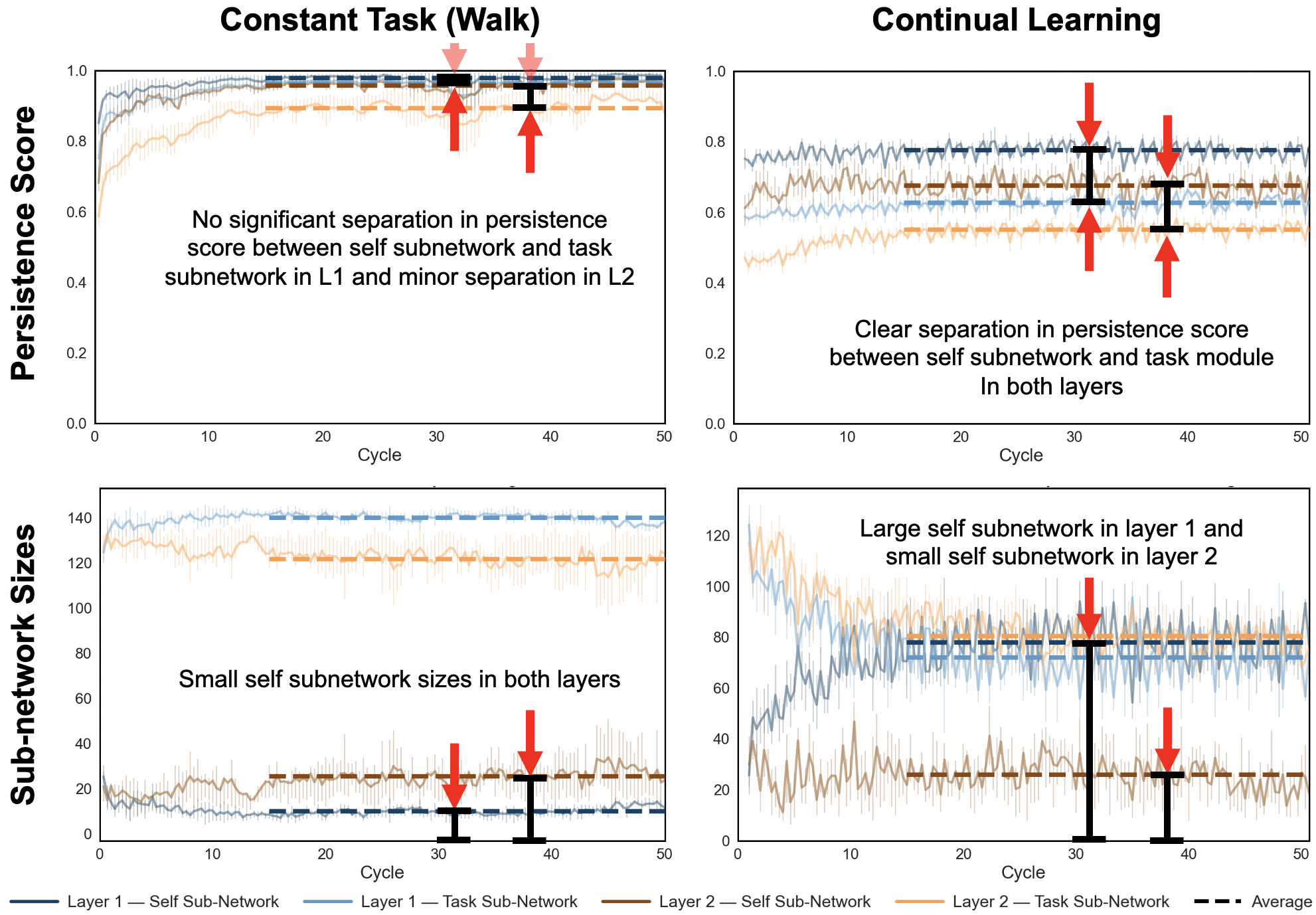
Across seeds, the continual-learning agent showed a mean self-versus-task separation of about 16.9 percentage points, while the constant-task baseline showed much weaker separation and far smaller stable subnetworks.
Just as importantly, this was not only a visualization artifact from one lucky run. The same pattern persisted across cycles, across seeds, and across architectural variations, with the strongest self-like structure showing up early in the network and then stabilizing over training.

Rather than building separate controllers, we trained a single robot policy through a repeating curriculum of distinct behaviors. That setup pressures the network to retain whatever body-related structure is useful across tasks.
Reward curves can tell you whether the robot improves. They do not tell you what the network is actually representing. We therefore analyzed hidden-layer activations across shared reference states to see which parts of the policy stayed stable and which parts reorganized.
We grouped neurons by co-activation structure, matched them across behaviors, and measured persistence over time. That let us separate the candidate self-like region from the more task-sensitive remainder of the network.
The point is not that the robot is “self-aware” in the human sense. The interesting result is narrower and, to us, more useful: under continual learning, a standard deep RL policy can spontaneously organize into a stable internal core alongside more behavior-specific components.
That suggests there may be a practical way to identify reusable body-related structure inside black-box controllers — without hand-designing a separate self-model. If that holds more broadly, it could matter for continual adaptation, transfer, debugging, and monitoring whether fine-tuning is preserving the right internal structure versus overwriting it.
More broadly, we like this project because it sits at an intersection we care a lot about: reinforcement learning, robotics, and interpretability. It is not just about making the robot move. It is about understanding what the controller has actually learned.
We built a broad stack around this project: RL training design, reproducible experiment infrastructure, checkpointing and resume tools, rollout/video tooling, and a full analysis pipeline for comparing internal network structure across runs, phases, and behaviors.
A big accelerator was Isaac-based vectorized simulation, which made it possible to iterate quickly and run large batches of experiments with much stronger reproducibility than a slower single-env loop.
On the engineering side it's Python, PyTorch, Isaac / simulation tooling, experiment configs, Bash/tmux, Git, and a lot of analysis infrastructure for turning raw checkpoints into interpretable results and publication-ready figures.